Health and Safety Policy for House Clearance Maidenhead
This policy sets out the commitment of our house clearance company to maintain safe working practices and protect employees, clients and the public during house clearance, rubbish removal and estate clearance activities. It applies across our service area and is intended to be proportionate, practical and consistent with statutory responsibilities. The policy outlines responsibilities, risk management, training, personal protective equipment and emergency procedures to ensure a safe working environment for everyone involved.Scope and Objectives
Our objectives are to: reduce injury and illness, minimise environmental impact, and ensure compliance with applicable health and safety law. This document covers all aspects of domestic and commercial house clearance services, including bulky item removal, sorting, recycling and disposal. It is designed to help our team, subcontractors and clients understand safe working practices and the expectations for performance within our rubbish company service area. Policy Principles
We will: identify hazards and assess risks; implement control measures proportional to the risk; provide training and supervision; maintain equipment in a safe condition; and review the policy at regular intervals. Prevention is emphasised over cure — safe systems of work, careful planning and clear communication are central to our approach. We encourage reporting of hazards and incidents to continuously improve performance.
Policy Principles
We will: identify hazards and assess risks; implement control measures proportional to the risk; provide training and supervision; maintain equipment in a safe condition; and review the policy at regular intervals. Prevention is emphasised over cure — safe systems of work, careful planning and clear communication are central to our approach. We encourage reporting of hazards and incidents to continuously improve performance.
Responsibilities
Management has overall responsibility for health and safety and will allocate adequate resources to implement this policy. Supervisors and team leaders are responsible for day-to-day enforcement, safe allocation of tasks and ensuring vehicles and equipment are fit for purpose. Employees and operatives are required to follow instructions, use PPE correctly and report unsafe conditions. Subcontractors must meet our standards and provide proof of competence before work begins.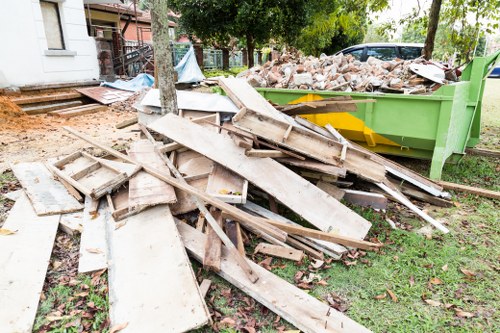 Risk Assessment and Control Measures
Before any clearance job we will carry out a site-specific risk assessment. Typical hazards include manual handling injuries, slips, trips and falls, exposure to sharp or contaminated waste, asbestos or hazardous chemicals, and vehicle movements. Control measures include safe lifting techniques, use of mechanical aids, segregation of waste streams, cordoning off hazardous areas and ensuring correct transport and disposal routes. Particular attention is paid to vulnerable structures, confined spaces and possessions requiring careful handling.
Risk Assessment and Control Measures
Before any clearance job we will carry out a site-specific risk assessment. Typical hazards include manual handling injuries, slips, trips and falls, exposure to sharp or contaminated waste, asbestos or hazardous chemicals, and vehicle movements. Control measures include safe lifting techniques, use of mechanical aids, segregation of waste streams, cordoning off hazardous areas and ensuring correct transport and disposal routes. Particular attention is paid to vulnerable structures, confined spaces and possessions requiring careful handling.
Safe Work Procedures and Safe Systems We employ written safe work procedures for common tasks such as furniture dismantling, mattress removal, kitchen clearances and electronic waste handling. Procedures include pre-job briefings, vehicle loading plans, two-person lifts for heavy items and verification of waste acceptance criteria at transfer stations. Clear signage and method statements are used where needed, and removal operations are planned to avoid public nuisance or obstruction of footpaths and access ways.
Training, Competence and Supervision All staff receive induction training covering manual handling, PPE use, hazard recognition and emergency response. Periodic refresher training and toolbox talks focus on common risks and seasonal hazards. Where specialised activity is required — for example handling hazardous materials or operating lifting equipment — only trained and certified personnel will be assigned. Supervisors monitor competence and provide coaching to maintain safe standards across the house clearance team.
 Personal Protective Equipment (PPE) and Tools
Appropriate PPE is provided and must be used where assessments identify a need. Typical PPE includes gloves, steel-toe boots, high-visibility clothing, eye protection and respiratory protection when dust or airborne contamination is present. Tools and lifting aids are maintained to manufacturer standards and inspected regularly. Employees must report damaged PPE or equipment immediately and remove faulty items from service until repaired or replaced.
Personal Protective Equipment (PPE) and Tools
Appropriate PPE is provided and must be used where assessments identify a need. Typical PPE includes gloves, steel-toe boots, high-visibility clothing, eye protection and respiratory protection when dust or airborne contamination is present. Tools and lifting aids are maintained to manufacturer standards and inspected regularly. Employees must report damaged PPE or equipment immediately and remove faulty items from service until repaired or replaced.
 Emergency Procedures, Incident Reporting and Waste Handling
In the event of injury, spillage or other emergencies, staff will follow established emergency procedures and report incidents promptly using our internal reporting system. Incidents are investigated to identify root causes and prevent recurrence. Waste is segregated at source into recyclable, hazardous and general streams; hazardous materials are handled only by qualified personnel and disposed of in accordance with regulations. Our rubbish removal and clearance processes emphasise recycling and reuse where practical to reduce landfill dependence.
Emergency Procedures, Incident Reporting and Waste Handling
In the event of injury, spillage or other emergencies, staff will follow established emergency procedures and report incidents promptly using our internal reporting system. Incidents are investigated to identify root causes and prevent recurrence. Waste is segregated at source into recyclable, hazardous and general streams; hazardous materials are handled only by qualified personnel and disposed of in accordance with regulations. Our rubbish removal and clearance processes emphasise recycling and reuse where practical to reduce landfill dependence.
Monitoring, Review and Continuous Improvement Performance is monitored through site checks, near-miss reports and periodic audits. We set measurable safety objectives, review compliance with this policy and update procedures as necessary. Feedback from staff and external audits informs changes and drives continuous improvement. This policy is reviewed at least annually or after significant incidents, changes in legislation or service expansion within the wider rubbish company service area.
Communication and Client Expectations Clear communication with clients is essential: pre-job information sheets outline what can be removed, any limitations and how hazardous items are managed. Clients are asked to declare hazardous materials or medical waste so we can arrange safe disposal. While this policy focuses on operational safety, it also seeks to protect client property and ensure a respectful, professional clearance service from initial quote to final sweep.
Implementation Statement This health and safety policy is supported by detailed procedures, risk assessments and training records. Management endorses the policy and expects all employees to embrace its principles. By combining good planning, competent staff and appropriate controls, we strive to deliver safe, reliable house clearance and rubbish removal services across our service area. Signed on behalf of the company, this policy represents our commitment to safety, legal compliance and continuous improvement.
